
Clermont County Court Records After Arrest
After a Clermont County arrest, the jail record and the court record answer different questions. The jail roster confirms current custody, booking date, charge lines, bond fields, and court labels. The court case shows what was filed with the clerk, what the prosecutor pursued, what the judge ordered, and how the case changed after the booking. For custody and booking details, use Clermont County jail inmate records. For photos connected to booking records, use Clermont County jail mugshots.
The jail FAQ points users to the Clermont County Clerk of Courts for added case information. Municipal Court handles misdemeanor criminal and traffic matters such as OVI, theft, assault, domestic violence, and drug offenses charged as misdemeanors. Common Pleas Court handles adult felony criminal cases. The Common Pleas Clerk says criminal cases may begin by indictment, bill of information, or bindover, which is the transfer of a felony path from a lower-court stage to Common Pleas.
Find Court Records After Arrest
Start with the jail roster if the person is in custody now. Capture the displayed case number, court, court date, charge text, and bond fields. Then move to the clerk portal that matches the court label. The official Municipal Case Access page links to criminal, traffic, and civil search for municipal cases. The official Common Pleas Case Access page links to the common pleas search for felony and other common pleas matters.
- Read the jail roster case number, court label, and charge text.
- Use Municipal Case Access for misdemeanor, traffic, and municipal criminal matters.
- Use Common Pleas Case Access for felony, indictment, bill of information, or bindover matters.
- Open the case and compare docket entries with the roster charge line.
- Check for later bond orders, amended charges, dismissals, pleas, sentences, or warrants.
- Contact the clerk when the web portal is incomplete or the record is older than the online index.
Both case-access pages warn that posted records may not reflect every change, pleading, or decision not yet filed or entered. Municipal records before May 1, 1996 are in the clerk office. Common Pleas records before January 1, 1988 are also in the clerk office.
Clermont County Case Search Fields
The live eServices portals are JavaScript-based, so the research captured gateway and process fields rather than a full static search form. The important local distinction is which court portal to use and when attorney access is separate from public search.
| Field or Channel | Type | Notes |
|---|---|---|
| Common Pleas Search | Official portal link | Use for felony and Common Pleas criminal case records. |
| Municipal Search Criminal-Traffic-Civil | Official portal link | Use for misdemeanor, traffic, and municipal criminal cases. |
| Attorney access request | Email process | Email CaseAccessRequests@clermontcountyohio.gov with court, name, email, bar code, organization, and phone. |
| Older records | Clerk office path | Municipal before May 1, 1996; Common Pleas before January 1, 1988. |
Clermont County Court Portals
The official Common Pleas Clerk case access page is one gateway for court records after a Clermont County jail arrest.
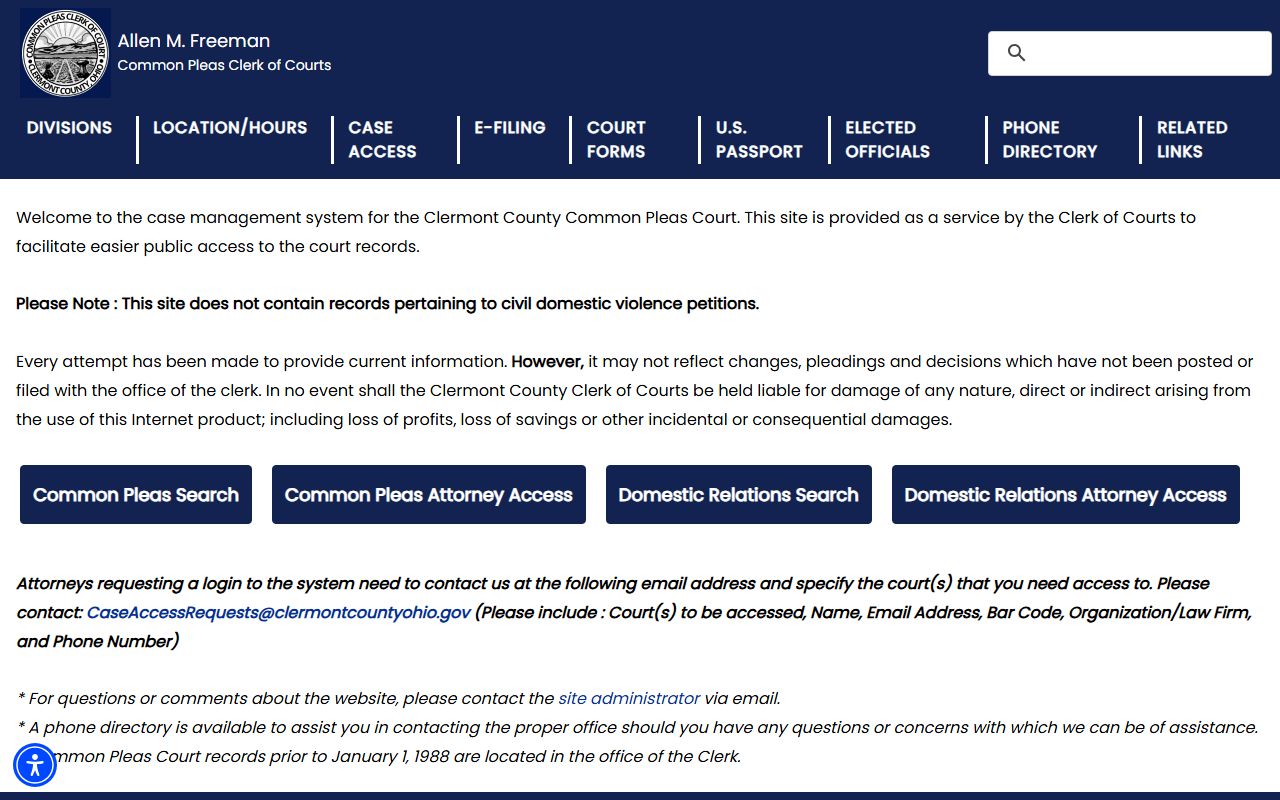
Use the case access gateway beside the jail roster because formal charges, docket events, and outcomes may not match the first booking line.
Charges After a Jail Arrest
A booking charge is not always the final court charge. Law enforcement may book a person on an alleged offense, then the prosecutor or court process determines what gets filed. In Clermont County, the Prosecutor Criminal Division represents Ohio in felony, misdemeanor, and juvenile prosecutions, while court clerks file and maintain the case documents. Charges can be added, amended, reduced, dismissed, bound over, or indicted.
| Document | Plain Meaning | Common Use |
|---|---|---|
| Complaint | A formal accusation filed to start or support a criminal case. | Common in misdemeanor and preliminary criminal matters. |
| Bill of information | A prosecutor-filed felony charging document used when legally permitted. | Some felony cases that proceed without grand-jury indictment. |
| Indictment | A grand-jury charging document. | Many adult felony cases in Common Pleas Court. |
| Bindover | A transfer from a preliminary or municipal stage to Common Pleas felony court. | Felony path from lower-court proceedings. |
Clermont County Charge Status
Charge status tells where the case stands. Do not treat an arrest as a conviction. A court record after a jail arrest can start with an accusation, then change after prosecutor review, plea negotiations, hearings, grand-jury action, or trial. A dismissed charge may still appear in a court history unless sealed or expunged under Ohio law.
| Status | What It Means |
|---|---|
| Pending | The charge is active and has not reached final disposition. |
| Amended or reduced | The charge text, degree, or count has changed from an earlier filing. |
| Dismissed | The charge ended without a conviction on that count. |
| Sentenced | The court imposed a penalty after conviction or plea. |
| Warrant or capias | The court may have ordered arrest or custody due to failure to appear or another court reason. |
Bond After Clermont Arrest
The roster displays bond type and bond amount for each charge line. Observed codes include OR, C/S, C/PR, CPRT, NONE, N/A, H, and SUMM. The research does not support translating every code as legal advice. Read them as roster codes and confirm release eligibility with the court or jail. One charge may have a dollar amount while another line has a holder, so a single payable bond does not always mean release is available.
| Bond Situation | How to Read It |
|---|---|
| OR or PR-style release | May refer to recognizance-type release, subject to court order and conditions. |
| Cash or surety-style bond | May require money or surety involvement. Confirm accepted payment methods with the court or jail. |
| No-bond or holder line | May block release even if another charge has an amount. |
| Changed bond order | Later court docket entries may override the first booking record. |
Warrants Before an Arrest
The sheriff's Most Wanted page is an official warrant-related public source, but it is not a full searchable warrant database. It lists selected wanted persons and warns the public to contact the Sheriff's Office rather than approach anyone. A bench warrant or capias may also appear in Municipal or Common Pleas docket entries for a specific case.
If a warrant leads to a jail arrest, the roster may show a local charge, a court case, a bond line, or a holder. For warrant verification, use the sheriff, the relevant court, or counsel. The research did not locate a complete public active-warrant search form for all Clermont County warrants.
Charges vs Convictions
A charge is an accusation or filed count. A conviction is a final legal outcome after a plea, verdict, or other qualifying disposition. This difference is central to court records after a jail arrest because early jail records often show alleged charges before the formal court path is complete.
| Charge | Conviction | |
|---|---|---|
| Stage | Filed accusation or booking allegation. | Final outcome after plea, verdict, or court finding. |
| What can change | May be amended, reduced, dismissed, or indicted differently. | May lead to sentence, supervision, jail, prison, fine, or other penalty. |
| Where to verify | Jail roster plus court docket. | Final docket entry and sentencing record. |
Sealed or Expunged Records
Ohio Revised Code 2953.32 governs sealing or expungement of conviction records and bail forfeiture records, subject to eligibility and exceptions. Sealing limits public access. Expungement can go further where allowed by law. Juvenile, sealed, expunged, confidential law-enforcement, and protected personal information can be restricted from public portals.
| Sealed | Expunged | |
|---|---|---|
| Public access | Hidden from normal public view after court order. | Treated as removed or destroyed where the statute permits. |
| Effect on portals | Public case or charge details may stop appearing. | Public display may be further limited by the order. |
| How it happens | Through the court process, not through a jail roster request alone. | Through the court process under Ohio eligibility rules. |
Prosecutor Role After Arrest
Clermont County uses a prosecuting attorney, not a district attorney title. Prosecuting Attorney Mark J. Tekulve's office represents the State of Ohio in felony, misdemeanor, and juvenile prosecutions in the county. The Criminal Division page says assistant prosecutors handle matters ranging from theft and drug offenses to violent crimes. The office lists a Common Pleas division, Municipal and Juvenile division, Civil division, and Victim Assistance contacts.
The prosecutor's role explains why the jail roster can differ from court records after an arrest. A booking line may reflect the arrest or initial holding reason, while a later court record may reflect a complaint, indictment, bill of information, bindover, amendment, plea, dismissal, or sentence. The clerk portal is the better source for those court events.
Restricted Arrest Court Records
Not every record is fully public online. Ohio public-records law includes exemptions, and court portals warn that not all changes or older files are reflected on the website. The Municipal Clerk public-records policy says no specific language is required for a request, requesters need not provide identity or intended use unless it helps and the requester is told it is not required, and denials or redactions must include an explanation and legal authority.
Important: Court, arrest, and jail data can change quickly. Verify any case status with the clerk or court before relying on it.